
Selection guide
Choosing an Air-Driven Hoist for a 650 kg Ex-Zone Lift
Short answer
Lift the 650 kg with a purpose-rated pneumatic chain hoist whose nameplate category matches the Ex zone. The payload hangs at about 6.38 kN, and a hydraulic cylinder fed compressed air cannot hold it: its seals are chosen for oil and it is not a rated lifting machine.
On this page
- How much force does a suspended payload put on the lifting point?
- Can a hydraulic cylinder be run on compressed air instead of oil?
- What was the air-operated hydraulic lift on that pallet truck?
- What bore would a cylinder need, and why is that still not a hoist?
- What should you actually hang in that space?
- What Ex marking must the hoist carry for the zone?
- What do you specify and verify before it lifts every day?
- Questions asked
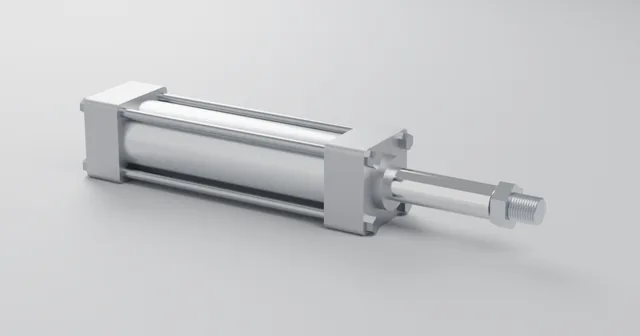
For a load that has to be picked from a hook in an Ex zone every day, the selection is a purpose-rated pneumatic chain hoist whose nameplate marking matches the zone, not a hydraulic cylinder run on compressed air. The payload alone, 650 kg, hangs at about 6.38 kN. Hydraulic cylinder seals are chosen to hold oil, not gas, so an air-fed cylinder leaks, drifts and has no load-holding brake, and a cylinder is not a rated lifting machine in the first place. Below: the force arithmetic, why the cylinder substitution fails, the bore it would need anyway, the Ex marking to demand, and a specification table you can hand to a supplier.
How much force does a suspended payload put on the lifting point? #
The payload alone pulls with about 6.38 kN: F = m × g = 650 kg × 9.81 m/s² = 6376.5 N, a calculated figure, and everything hanging below the hook adds to it before motion does.
That is a calculated example for the stated payload, not a measured force. The mass you select on is the total suspended mass: payload plus slings, spreader beam and any attached tooling, with each of those masses taken from a nameplate or drawing rather than a guess. Starting and stopping add force on top of the static value; a rated hoist covers those effects inside its own rating, which is exactly why you select a rated machine instead of deriving one from statics.
Can a hydraulic cylinder be run on compressed air instead of oil? #
No, and not for sizing reasons: hydraulic cylinder seals are engineered to hold oil between the cylinder's components, they are not gas-tight, so compressed air bleeds past them and the rod drifts under load.
Seal manufacturers' technical guides describe these seals as closing the gaps between cylinder components in oil service, SKF's general technical information on hydraulic seals being one such guide, and everything about them assumes a lubricating oil film and the viscosity of oil. Air provides neither. It strips lubricant, slips past edges that hold oil, and does so at full working pressure. The symptoms in service are constant drift, audible leakage and a rod that settles whenever supply dips.
Air is also compressible, so a cylinder balanced on it behaves like a stiff spring: pressure ripple moves the load, and a hose failure releases stored energy at once. A hoist holds its load on a mechanical brake and is proof-tested and rated as a complete machine. Feeding air to a hydraulic cylinder gives you none of that, which makes the substitution a misapplication rather than a clever shortcut.
What was the air-operated hydraulic lift on that pallet truck? #
An air-driven hydraulic pump: a purpose-built product class in which compressed air drives a pump that sends oil, never air, to the cylinder, sound for presses and clamps but the wrong start for a hook lift.
These units exist and are used in Ex areas, because the air motor replaces the electric one. On a pallet truck the geometry also does half the work: the cylinder pushes a linkage from below and the load rests on forks, not on a hook. None of that transfers to an overhead pick in a restricted space. Going this route for your lift would still leave you owing pilot-operated check or counterbalance valves rated for the load, an oil-tight circuit inside the Ex zone, and a support structure carrying the full force, in effect a one-off lifting machine you would have to engineer and rate yourself. That is a worse use of a tight space than a chain hoist that already carries a rating.
What bore would a cylinder need, and why is that still not a hoist? #
At 6 bar, a cylinder would need about 116 mm of bore just to balance that payload with zero margin, and it would still have no way to hold the load once the air vents.
Calculated example for those inputs, using the ideal force relation that also does the work when sizing a hydraulic cylinder bore for a linked lift:
- Required force: F = 6376.5 N, the calculated payload force from above
- Supply pressure: P = 6 bar = 600,000 Pa
- Piston area: A = F ÷ P = 6376.5 N ÷ 600,000 Pa = 0.01063 m² = 106.3 cm²
- Bore: D = √(4A ÷ π) = √(4 × 106.3 cm² ÷ 3.1416) = 11.6 cm ≈ 116 mm
That bore ignores seal friction, side load and any design factor; doubling the force for margin takes it to roughly 165 mm. It also holds nothing by itself: let supply sag to 5 bar and the same bore delivers F = 500,000 Pa × 0.01063 m² = 5315 N, about 1.06 kN short of the load, so the load descends until something stops it. In a bare cylinder, nothing does, which is the whole argument for a machine with a brake.
What should you actually hang in that space? #
A pneumatic chain hoist with a rated capacity above the total suspended mass, a 1000 kg class unit for this job, because one rated package buys you the motor, the brake, the limiter and the Ex marking.
The compactness you need in an Ex zone comes from the absence of an electric motor: no motor, no flameproof enclosure at the hook. What remains is an air motor, a brake that holds without air, a chain and container, and a pendant running on air lines. As a rule of thumb, a 1000 kg class unit keeps a daily lift of this payload plus rigging well clear of the nameplate. Where the zone requires it, specify spark-resistant execution of the hook and load chain. Take the required air pressure and free-air consumption from the datasheet of the exact unit, and confirm with a gauge at the hoist inlet under flow. State the duty plainly, daily service, so the maker's duty class has to match it.
What Ex marking must the hoist carry for the zone? #
Under the ATEX equipment directive 2014/34/EU the category encodes the zone: category 1 for zones 0 and 20, category 2 for zones 1 and 21, category 3 for zones 2 and 22, and the nameplate must match the classified area.
Three more fields on that nameplate decide suitability. Group II means equipment for surface industry, mining being group I. The letters G, D or GD say whether the certification covers gas atmospheres, combustible dust, or both. The temperature class, or marked maximum surface temperature, must sit below the ignition temperature of the atmosphere around it. Because a pneumatic hoist is non-electrical equipment, its real ignition hazards, static discharge, hot surfaces and mechanical sparks, are assessed under ISO 80079-36, and the maker's marking is the evidence that they were. Where a site uses the North American Class/Division system instead of zones, the nameplate class and division must match that area the same way. Removing the electric motor removes one ignition source, not the requirement to be assessed.
What do you specify and verify before it lifts every day? #
Seven items, each with its own source document: capacity, Ex marking, headroom, support structure, air supply, load holding and duty, all fixed before the unit is ordered and proven with a test lift.
| Item | Decision for this lift | Where it comes from |
|---|---|---|
| Rated capacity | Above the total suspended mass of the payload plus hook block, sling and tooling; a 1000 kg class unit | Hoist nameplate; rigging nameplates |
| Ex marking | Category matching the zone, gas or dust group, temperature class | Area classification drawing |
| Headroom and travel | Clearance under the support and full lift height, plus room for the chain container | Site survey |
| Support structure | Beam and trolley rated for hoist mass plus the 6.38 kN load and stopping effects | Structural design, separate from the hoist |
| Air supply | Required pressure and free-air consumption, measured at the hoist inlet under flow | Datasheet of the exact unit; gauge reading |
| Load holding | Mechanical brake that holds with no air | Manufacturer documentation |
| Duty | Daily service, cycle count and hours | Maker's duty class for the unit |
Commissioning is a controlled lift with the real load: raise, stop, hold and lower through full travel while a gauge at the inlet shows supply holding steady, then confirm the load stays put on a commanded stop with the supply isolated. Drift, new noise or sluggish response are rejection items, not tuning items, if they depart from the manufacturer's instructions. From the first test lift onward nobody stands or reaches beneath the suspended load, and the support structure is verified before that lift, not after.
Questions asked
Does an air chain hoist need any electrical supply at the hook?
No. Motor, brake and pendant can all run on compressed air, which is why these hoists suit Ex zones where an electric hoist would need a heavy flameproof enclosure. Route the pendant air lines and the motor exhaust exactly as the manufacturer instructs, because exhaust mist and hose routing are part of the approved installation.
What holds the load if the air supply fails?
On most air chain hoists a spring-applied brake sets whenever air pressure falls and releases only when the motor is commanded, so a supply loss stops and holds the load instead of dropping it. Confirm that behavior on the datasheet of the exact unit, and treat certified load holding as a purchase requirement, never an assumption.
How close to the nameplate capacity can we lift every day?
The nameplate rating already builds in the machine's own design factors, so you do not add another safety multiple to the load. What matters is duty: a lift that runs daily should sit comfortably under the rating, and around two-thirds is common working practice, which is one more reason a 1000 kg class unit beats a smaller frame for this load plus rigging.
Is ordinary plant air at 6 bar enough to run the hoist?
That is a unit-specific number: required pressure and free-air consumption come from the datasheet of the exact hoist, and the only reading that counts is a gauge at the hoist inlet while it lifts the load. When an air hoist starts poorly under load, the usual culprit is an undersized or kinked supply line, not the compressor.