Troubleshooting
Why a Stepper Motor Rattles Instead of Turning: Check Wiring First
Short answer
A stepper that rattles instead of turning has almost always lost one phase: a winding that carries no current, usually through a loose or broken lead at the drive terminal. Check every terminal and measure winding continuity before you replace the motor or the drive; the motor is rarely at fault.
On this page
A stepper motor that rattles instead of turning has almost always lost a phase: one winding carries no current, so the rotor cannot follow the stepping field and vibrates in place with almost no torque. On a mill Z-axis this traces to a loose or broken lead at the drive terminal far more often than to a failed motor, because steppers rarely go bad. Work through the terminals, the winding resistance and then the drive channel, in that order, before replacing anything.
Why a lost phase makes a stepper rattle #
A two-phase stepper produces a rotating magnetic field only when both windings carry current in the right sequence. Open one winding and the field stops rotating; it merely alternates along a single axis. The rotor is pulled back and forth between fixed positions — that is the rattle you hear — and the axis delivers almost no usable torque.
The sound alone does not assign the cause. A rattle that appeared suddenly, at every speed, on an axis that ran fine the day before is a current-path problem: a connection or a conductor, not tuning. A rattle that comes and goes in one speed band, with smooth running either side of it, is resonance or a stall-margin problem, which why a stepper stalls in one band under load works through separately.
Match the symptom to the cause #
| What you observe | Likely cause, cheapest to check first | Confirming check |
|---|---|---|
| Sudden rattle at every speed on a previously working axis | Loose or broken lead: backed-out terminal screw, fractured wire strand, damaged ferrule | Tug-test every lead on the axis, then measure winding resistance |
| Rattles in one speed band only, smooth below and above it | Mid-band resonance or acceleration set too high | Jog through the band at reduced acceleration and see whether the band moves |
| Jerky short steps, or motion in the wrong direction | Phase pairs swapped or mis-paired at the terminals | Identify each coil pair with an ohmmeter and connect each pair to its own driver output |
| Weak rattle, hot motor, stalls under light load | Phase current set far from the motor's rated current, or a mechanical bind | Compare the drive's current setting with the motor nameplate and spin the unloaded screw by hand |
The fourth row's heat usually lives in the current setting, which why a stepper motor runs hot explains in detail.
A loose joint is worse than a clean break. A fully open winding simply contributes no torque, but a contact that makes and breaks arcs each time it closes, and the local heating pits the terminal and can stress the driver's output stage — the same mechanism that lets a loose motor terminal burn without tripping a breaker. Re-terminate an intermittent connection as soon as you find it; do not run production on it.
Ohmmeter check on a motor with 1.4 Ω windings #
The inputs, taken as a worked example for a two-phase bipolar motor on a mill Z-axis:
- Rated phase resistance: 1.4 Ω per winding — an example datasheet value; read the real figure from the datasheet for your exact motor.
- Measured winding A: 1.45 Ω, meter probes on that winding's two motor leads.
- Measured winding B: 1.40 Ω.
- Measured between winding A and winding B: over range, no continuity.
The rule: on a healthy two-phase bipolar motor, both windings read close to the datasheet figure and match each other within a few percent (a rule of thumb, not a standard), and there is no continuity from one winding to the other.
The arithmetic: mismatch = (1.45 Ω − 1.40 Ω) ÷ 1.40 Ω × 100 = 0.05 Ω ÷ 1.40 Ω × 100 = 3.6%.
The result: 3.6% — the two windings agree with each other and with the datasheet figure, and the phases are isolated. These are example readings chosen to show the arithmetic, not measurements from a specific motor.
The decision: readings matched within a few percent means both windings carry current, so the lost phase is upstream in the harness or the drive channel, and the next stop is the terminal and continuity checks below. Either winding reading over range, or the two windings showing continuity between each other, puts the fault in the motor or its cable, where no drive setting will fix it.
Isolate the fault one swap at a time #
Work from the cheapest test to the dearest, and change one item per test:
- Remove power and lock out the machine before opening the box or touching a terminal.
- Unload the motor: loosen the belt or uncouple the screw so the shaft spins free by hand. That separates a mechanical bind from an electrical fault in one move.
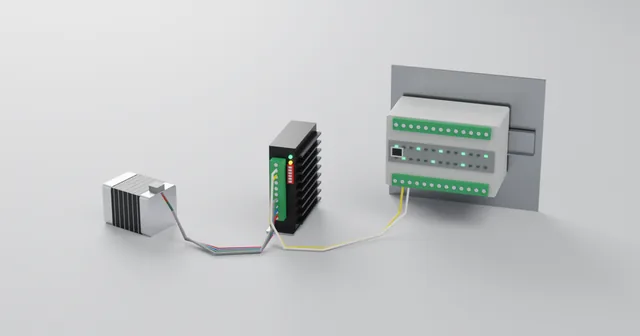
- Inspect the whole conductor path, from the drive's terminal block through the cable to the motor connector. Tug-test every lead and look for wires hanging free, backed-out screws and crushed ferrules.
- Measure both windings at the motor leads with the motor disconnected, as in the worked example above. If the leads are unmarked, the ohmmeter method described in running a 6-wire unipolar stepper motor on a bipolar driver identifies coil pairs the same way.
- With the motor readings good, check continuity from the drive terminals to the motor leads on every conductor, flexing the cable as you read. An intermittent break often shows only while the cable moves.
- Move the suspect motor to a known-good axis. If the rattle follows the motor, the motor or its cable is at fault; if the original axis still rattles, the fault sits in that drive channel.
- Move the drive itself to another channel, even one you rarely use. Lifting the drive out of its corner of the box is what usually exposes a lead that has been hanging loose where the layout hid it.
- Reconnect, restore power and jog the axis slowly in both directions before refitting the belt.
Confirm the repair under load #
Jog the unloaded motor at low and moderate speed in both directions. It should run quietly, and the energized shaft should resist turning by hand. Refit the belt, run the full travel, and check for lost steps by returning to a reference position and comparing a dial indicator reading taken before and after several cycles. Wiggle the harness while the axis moves: any change in sound means an intermittent connection is still in there. If the fault stalled the axis hard enough to lose position, the motor itself is usually unharmed — stepper motor lost steps after a stall: is it damaged covers that question.
Keep the connection from failing again #
Re-terminate moving-axis cables with ferrules and add strain relief where the harness leaves the box; vibration and repeated flexing are what loosened the screw in the first place. Recheck terminal tightness after the first week of running. Never connect or disconnect motor leads while the drive is powered: hot-plugging a stepper can kill the driver's output stage instantly. And if the axis runs through a long cable, size the conductors for the current and the run — the trade-offs in wiring a unipolar stepper motor over Cat5 or shielded cable apply to any moving harness.
Questions asked
Why does a stepper rattle in one speed band and run fine outside it?
That pattern is mid-band resonance, not a lost phase. The rotor cannot absorb the energy delivered in that speed range, so it oscillates until the speed moves past the band. Lower the acceleration, change the microstepping, or adjust the drive's current-set potentiometer: turn it down and bring it back up slowly to confirm the setting is stable. A wiring fault rattles at every speed instead.
The rattle stopped on its own. Is the fault gone?
No, and that behavior itself points to an intermittent connection. A broken conductor that re-makes contact through vibration or cable movement runs normally until it shifts again, and each make-and-break arcs at the terminal. Treat a fault that comes and goes as a live intermittent: tug-test the harness and re-terminate the suspect lead before it fails for good or damages the driver output.
How do I tell a motor fault from a drive fault without spares?
Measure winding resistance at the motor leads with the motor disconnected, then check continuity through the cable from the drive terminals. If both windings read their datasheet value and every conductor is continuous, move the motor to a known-good axis: a fault that follows the motor points to the motor or its cable, and one that stays with the axis points to the drive channel or its wiring. Change one item per test.
The rattle started right after I moved the machine. Does that change the diagnosis?
It strengthens the wiring diagnosis. Moving a machine flexes harnesses at the connectors and lets terminals back out or ferrules fracture where a cable is strained. Inspect the full path the Z-axis cable takes, tug-test each lead at both ends, and check that no conductor is pinched under a component that was lifted or repositioned during the move, before suspecting the motor or the drive.