Selection guide
Small Offload Conveyor Selection for a Pick and Place
Short answer
Size a small offload conveyor from three constraints before comparing suppliers: the belt envelope (8 by 18 inches, frame no more than 2.5 inches high excluding the drive), a fixed belt speed above the spacing minimum of about 4.3 ft/min, and a 4,000,000-cycle life over five years. Buy a supported catalog low-profile unit rather than building one, and solve picker timing with the stroke, not with a longer conveyor.
On this page
- What size offload conveyor fits the machine?
- How fast must the belt run to keep parts separated?
- Does a longer conveyor fix a slow picker return?
- How much cycle life does an offload conveyor need?
- What should a small conveyor quote include?
- Should you buy or build a small offload conveyor?
- Questions asked
Size a small offload conveyor from three constraints before you open a single supplier catalog: the physical envelope, the minimum belt speed, and the cycle-life target. Once those three are fixed, the supplier comparison is a short list, and the buy-versus-build question answers itself. For this kind of cell the envelope is an 8 by 18 inch belt on a frame no taller than 2.5 inches excluding the motor and drive, the speed follows from the part spacing at one part every 7 seconds, and the life target is 4,000,000 cycles over five years. The decision at the end of those checks is to buy a supported catalog low-profile conveyor, not to build one in the shop.
What size offload conveyor fits the machine? #
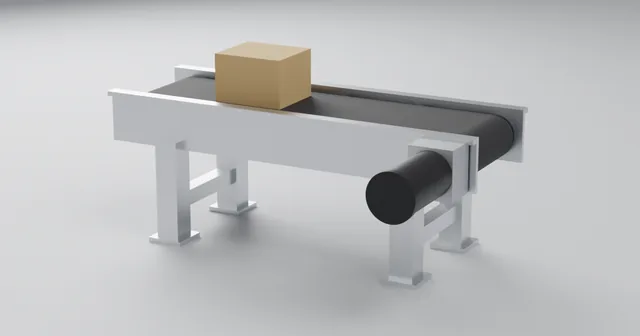
Start from the measured envelope: an 8 inch wide by 18 inch long belt covers this transfer, lengths from 18 to 24 inches also work, and the belt section must stand no more than 2.5 inches high excluding the motor and drive. Measure the clear width and length at the mounting location and the tote opening the part must land in, then compare both readings against the conveyor's dimensional drawing, not its catalog headline. The height limit expressly excludes the motor and drive, so the drawing must show the overall height of the belt section separately from the drive projection, the mount, the wiring and any guarding. A frame-height match alone does not prove the assembly fits.
Custom length, width and height are standard in this conveyor class: low-profile families are routinely made to a requested envelope, so treat 18 to 24 inches of length and the width you need as orderable, not as special. Read published heights with care. One low-profile slider-bed family lists an overall frame height of about 3 3/8 inches including a flared steel side skirt, and a very low profile design built on 15 mm pulleys sits lower still; both are low profile by marketing, and only the dimensional drawing of the exact model tells you whether the belt section clears your height limit before the drive is added.
How fast must the belt run to keep parts separated? #
The belt only has to keep ahead of the part interval: with 6 inches of spacing between parts, the minimum fixed belt speed is 6 in divided by 7 s, which is 0.86 in/s, or 51.4 in/min, which rounds to 4.3 ft/min. The part rate itself is 60 divided by 7, about 8.6 parts per minute, but the belt never has to match that rate; it only has to move each part far enough before the next one lands. The minimum speed is spacing divided by the interval. With a 4 inch long part and 2 inches of clearance, the spacing is 6 inches, which sets the number above.
Any fixed speed above that preserves separation. Ordering around 10 ft/min gives roughly a 2.3 times margin and still keeps the part easy to catch at the tote; a belt much faster than that risks the part skidding on landing or running past the drop point, which you confirm with a discharge test using real parts, not with arithmetic. If the process allows accumulation, even the minimum stops mattering, but then you are managing pile-up at the tote instead of spacing on the belt, so decide which condition the process needs before ordering the drive. The motor and gearing behind that speed are a separate sizing step; the walkthrough of conveyor motor drive sizing without a design manual covers that side.
Does a longer conveyor fix a slow picker return? #
A longer conveyor does not fix a slow picker: conveyor length and picker stroke are separate dimensions, and with a picker waiting at the far end, the return travel of an oversized stroke can consume around a quarter of the 7-second part interval. A pneumatic transfer cylinder has two end positions. It cannot wait at the far end, hold the pick position, and stop somewhere in between, so every inch of transfer stroke is also an inch of return travel before the next pick. Adding belt length does not shorten the cylinder stroke.
The numbers make the point. Replacing a 7 inch stroke with a 24 inch stroke adds 17 inches of return travel. At an illustrative traverse speed of 10 in/s, that is 1.7 seconds of pure return added to every cycle, about a quarter of the part interval, before you count the image wait, the grip and the place. That is why the proven arrangement keeps the short stroke with a secondary up-and-down cylinder at its end and lets the conveyor carry the part the extra distance instead of the cylinder. If you are choosing a stroke for a new transfer, the walkthrough of long-stroke linear actuator sizing for a 500 N push shows how stroke, force and speed trade against each other.
How much cycle life does an offload conveyor need? #
Size every conveyor component for 4,000,000 cycles: at the stated minimum of 800,000 parts per year, a five-year design without major overhaul needs 800,000 × 5 = 4,000,000 cycles of belt, bearing and drive life. Convert the production target into duty before comparing conveyors. At 8.6 parts per minute, the annual minimum is about 93,000 minutes, or roughly 1,556 hours, of continuous running per year. That is the duty the belt, the pulley bearings and the drive all carry, and it is the number to put in front of a supplier when you ask for life data.
Field evidence supports the picker half of the cell already: the short-stroke cylinder arrangement with its secondary vertical cylinder has passed 10 million cycles without seal failure, about 2.5 times the five-year target, while a rodless cylinder was ruled out on reported life expectancy in exactly this high-cycle transfer duty. The conveyor deserves the same standard. Ask specifically for belt life, bearing life and drive duty ratings, and reject any unit whose components cannot show the 4,000,000-cycle duty, because the five-year, no-major-overhaul rule applies to the offload conveyor as much as to the picker.
What should a small conveyor quote include? #
A usable quote states the overall frame height and the motor-and-mount projection outside the 2.5 inch height limit, a fixed drive speed at or above the belt-speed minimum, and the replacement-belt supply, because the height limit excludes the drive assembly. Treat the rows below as pass or fail: custom length, width and height are standard orderable options in this conveyor class, fixed speed is a normal drive option, and a supplier who cannot produce life data for the exact model has not met the duty. Also confirm the replacement belt is a supported spare for that model, because at this cycle count the belt is a wearing part with a schedule, not an indefinite item.
| Constraint | Target for this offload | What to verify in the quote |
|---|---|---|
| Belt envelope | 8 in wide by 18 in long, 18 to 24 in length acceptable | Dimensional drawing: overall length, width and drive projection |
| Frame height | No more than 2.5 in excluding motor and drive | Published overall height of the exact model, plus mount and guarding |
| Belt speed | Fixed speed above the 4.3 ft/min minimum | Fixed-speed rating on the drive datasheet |
| Cycle life | 4,000,000 cycles over five years | Belt, bearing and drive life data for that model |
Should you buy or build a small offload conveyor? #
Buy a catalog low-profile conveyor: against a 4,000,000-cycle duty and a five-year no-overhaul rule, factory support and a guaranteed supply of spare belts outweigh the lower parts cost of a shop-built frame, and used units rarely match this envelope. A machine shop can roll a frame, bore idler bearings and fit a drive roller, but shop construction does not bring a design life statement for the belt and bearings, factory support when the drive fails, or spare belts three years from now. Search the surplus route if you want: secondhand small conveyors in this exact envelope are rare finds, and the used pick and place buyer's guide walks through what to verify before reusing secondhand automation hardware at all.
The part handling is already decided: a vacuum cup, chosen for having no moving gripping parts and proven on similar parts, which leaves the conveyor carrying only landed parts. Validate the cup on the actual part surface and drop height before approving the drawing; the comparison of friction, clamp and vacuum part retention on a moving nest explains when a vacuum hold is the right choice. Dusty or porous parts change the vacuum story too, and the guide to fixing ejector clogging in dusty vacuum pick and place work covers that failure mode.
One safety note: guard the nip points at the drive roller and idler, and interlock the conveyor with the cell guarding as the machine's risk assessment requires.
Decision, for each route. Buy when the three constraints check out on the drawing and the datasheet: order the low-profile unit, keep the short picker stroke, and order the spare belt with the machine. Build only when your shop commits in writing to the belt, bearing and drive life data, the maintenance access and the spare-belt supply; otherwise the saved parts cost returns as downtime. A used unit is worth taking only when it meets the same three constraints and its remaining life is documented, not assumed.
Questions asked
How many parts per minute is one part every 7 seconds?
Divide 60 by 7, which gives about 8.6 parts per minute. Over a year at the 800,000-part minimum that is roughly 1,556 hours of continuous running, a useful check when you compare a conveyor's rated duty against what this cell will actually demand of it.
What fixed belt speed should I order?
Any fixed speed above the spacing minimum works; for this layout that minimum is about 4.3 ft/min, so ordering around 10 ft/min gives roughly a two-times margin while keeping the part easy to catch at the tote. Confirm the offered speed on the drive datasheet of the exact conveyor, and test the discharge with real parts before approving the drawing.
Does a vacuum cup change the conveyor requirement?
No. Once the cup releases, the conveyor only has to contain and carry the part, so the envelope, speed and life targets stand unchanged. What does change is the release check: verify surface porosity, cup size and drop height so the part lands flat and inside the belt width instead of tipping at the edge.
When is a rodless cylinder acceptable in a pick and place?
Where the duty is light or the cycle count per year is low enough that the band or seal wear rating is never approached. In this cell, reported field life of rodless units in similar high-cycle transfer duty fell short of the multi-million-cycle target, which is why the proven short-stroke cylinder arrangement with a measured ten-million-cycle history stayed.