
Motion Library
Earlier articles
Troubleshooting
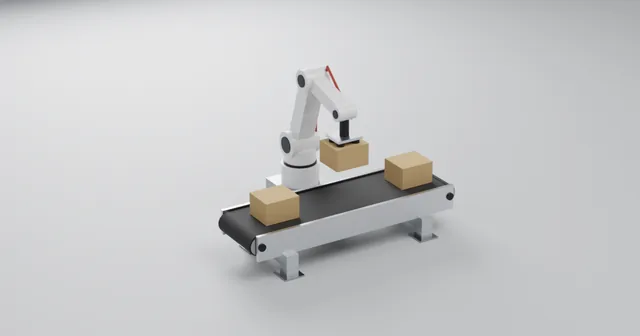
Why Conveyor Tracking Follows World X Instead of Z
Tracking motion follows world X because the conveyor tracking reference frame maps the tracked displacement into world X, not because the robot is elevated or rotated. A translation and a 180-degree Y rotation move the origin and reverse axes but never exchange X with Z, so the frame chain must be measured, not the robot repositioned.
Troubleshooting
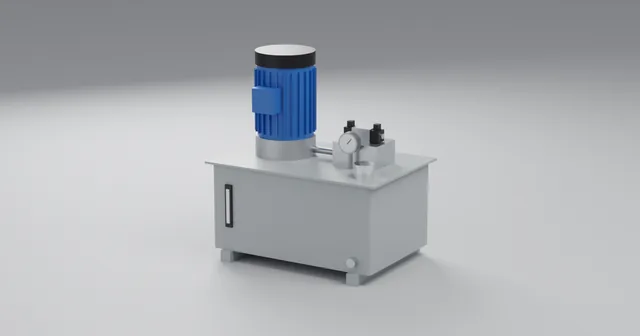
Why a hydraulic valve manual button stays depressed
A manual override that stays depressed means either the solenoid is still energized or the valve spool is mechanically stuck. Unplug the coil connector, never pull an energized coil off its core, and press the button again: if it still stays in, replace the valve. If valves shift freely by hand but nothing on the machine moves, test the pressure switch contact with an ohmmeter, pump stopped and running.

Explainer
Hexapod Travel Ranges Are Interdependent, Not Independent
A hexapod's published travel maxima apply only when every other coordinate is at zero. Combined translation and tilt shrink the usable workspace, so selection means mapping the whole simultaneous motion trajectory into the coupled workspace and checking payload and holding force against the mounting orientation, not reading one axis limit at a time.
Explainer
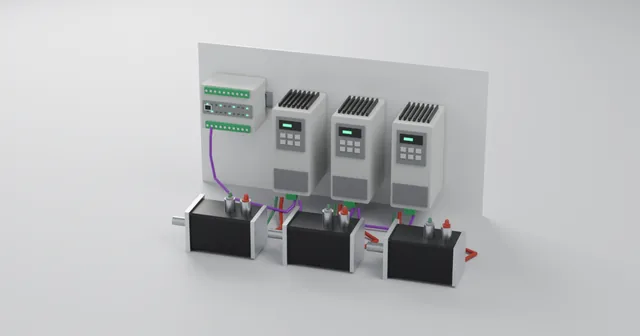
Same scan does not mean synchronized servo axes
Starting three pulse-commanded servo drives in the same PLC scan launches three independent trajectories, not one synchronized motion. Synchronization is decided by relative surface displacement during the interval the axes share the work, measured against the process tolerance. Axes that must stay locked need a master–follower or electronic-gearing relationship; axes judged only on their own endpoints can run as independent pulse moves with approximate simultaneous starts.
Selection guide
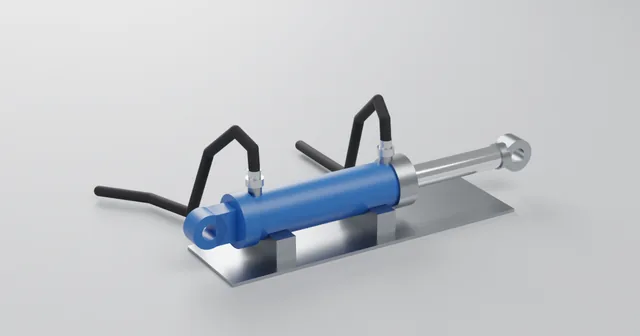
Running a hydraulic cylinder on low-pressure engine oil
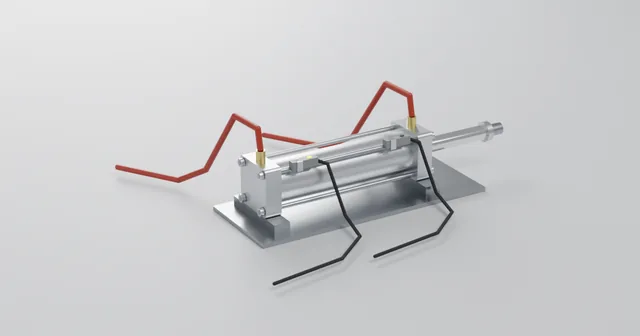
Low pressure is the easy limit. Every valve, cylinder, seal, hose and fitting needs documented compatibility with petroleum engine oil at up to 250 °F, capacity for the circuit flow, and the exact spool center condition. Pneumatic hardware is a candidate to verify against those four limits, never a drop-in; the worked arithmetic shows force and speed decide the bore.
Comparison
Timed Dwell at Full Extension for a Pneumatic Cylinder
Hold the directional valve commanded forward after the extended-position signal trips, and delay only the reversal command. An all-pneumatic delay (meter-in flow control feeding a small reservoir that slowly builds pilot pressure) fits simple cycles; a recycling solid-state timer or PLC timer driving the solenoid valve fits when timing accuracy, adjustment, or coordination with other machine logic decides. Timing accuracy is the decision criterion.

Explainer
What changes when a 60 Hz servo motor runs on a 50 Hz supply
Leave the voltage unchanged and the volts-per-hertz ratio rises exactly 20% (1.92 to 2.30 V/Hz), so magnetizing current and heating climb; a line-fed motor also turns at 83.3% of its 60 Hz speed. An inverter-fed servo amplifier only sees slightly deeper DC bus ripple. On a line-fed motor, drop the supply to about 96 V with an autotransformer to restore the 60 Hz flux, then prove the machine with a worst-cycle winding temperature test.
Troubleshooting
Why a stepper motor will not turn from microcontroller pins alone
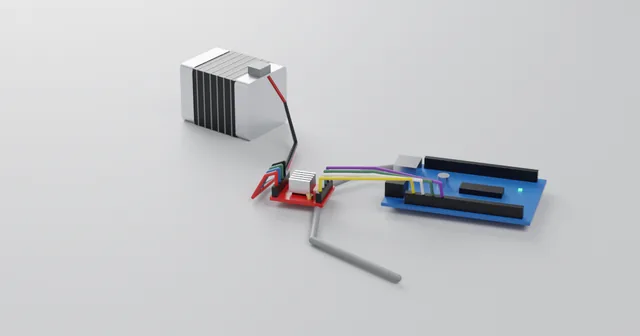
A microcontroller pin sources about 25 mA and a full port about 100 mA, while a stepper phase draws 100 mA to 2 A, so directly wired pins cannot energize the windings — the motor stays still until a ULN2003, L293D or A4988 driver stage carries the phase current. Three firmware faults pile on: loops initialize with == instead of =, delay counters overwrite the step count, and the buttons are read from PORTB while TRISD configures them on PORTD.
Selection guide
What a servo motor needs to hold torque at 7,500 rpm
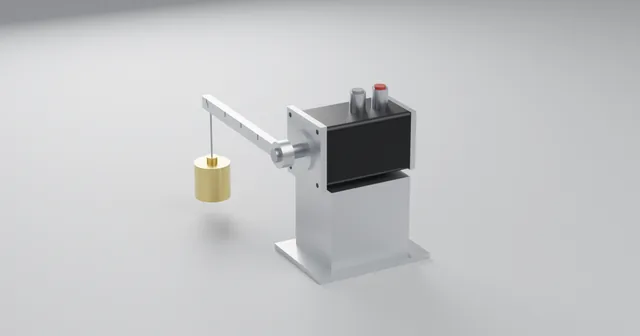
A 100 oz-in load held at 7,500 rpm is about 0.74 hp (0.55 kW) of continuous shaft power, so pick the motor from the continuous region of its torque-speed curve at that speed and the drive from the continuous current that torque implies over the duty cycle. Rated maximum speed and feedback rating close the check.
Explainer
What Signals a ±10 VDC Analog Servo Amplifier Expects
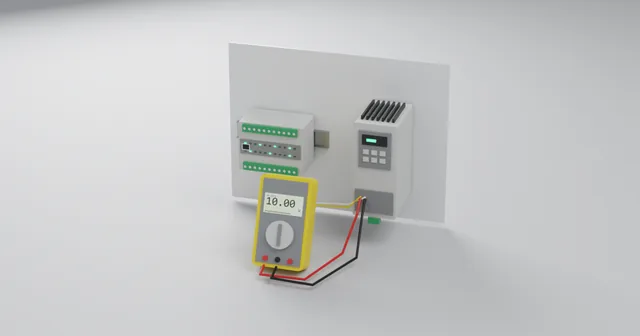
A ±10 VDC analog servo amplifier expects a bipolar analog command: sign sets direction, magnitude sets how hard the amplifier drives the motor, and the motion controller closes the position loop from encoder feedback. A replacement front end must supply bipolar analog outputs, encoder inputs and enable, fault and limit wiring — never raw step-and-direction pulses.
Troubleshooting
Why a PWM-controlled stepper restarts with no pulses for seconds
The frequency operand can rise all it likes; while the pulse output is off for an out-of-range operand or waiting for its next period, no pulses reach the driver. It resumes at the already-elevated ramp value, above what the motor can start from, so the motor rumbles. Restart from a valid low starting frequency held for a fixed delay after the run bit, with one write per scan, then ramp.
Explainer
Conveyor tracking offline simulation: what it can verify
Offline simulation with a static coordinate frame verifies reach, path structure and clearance before the robot exists. It cannot verify moving-frame synchronization: as a calculated example, at a conveyor speed of 300 mm/s with 0.5 s between detection and pick, the target moves 150 mm, so frame conversion and tracking checks stay on the real controller.